Why Financial Literacy is the Ultimate Power-Up for Students
In the modern educational landscape, students are often equipped with the Pythagorean theorem, the periodic table, and the nuances of Shakespearean sonnets. However, there is one “hidden skill tree” that often goes ignored until the first student loan bill arrives or a credit card application is denied: Financial Literacy.
Financial literacy isn’t just about counting pennies; it is the ultimate “power-up” that transforms a struggling student into a strategically focused professional. In an era of rising tuition costs and “buy now, pay later” consumerism, understanding the language of money is no longer optional—it is a survival skill.
The High Cost of Financial Ignorance
According to a 2023 report by the National Endowment for Financial Education (NEFE), nearly 88% of U.S. adults said they wished they were required to take a financial literacy course in high school. For students, the stakes are even higher. The average federal student loan debt in the United States hovers around $37,338 per borrower. Without a fundamental grasp of interest rates, debt-to-income ratios, and compound growth, students often find themselves in a financial hole before they even land their first entry-level job.
Navigating complex academic modules while managing a personal budget can be overwhelming. Many students find that seeking professional finance Assignment help allows them to master the theoretical side of fiscal management while they simultaneously apply those lessons to their real-world savings and expenses. By understanding the “why” behind the numbers, students can move from financial anxiety to financial agency.
Why Financial Literacy is Your Greatest Asset
1. The Magic of Compound Interest
Einstein famously called compound interest the “eighth wonder of the world.” For a student, time is the greatest multiplier. Investing even $50 a month at age 20 can result in significantly higher wealth by age 60 than investing $500 a month starting at age 40. Financial literacy teaches students to start early, leveraging time to build a safety net.
2. Avoiding the Debt Trap
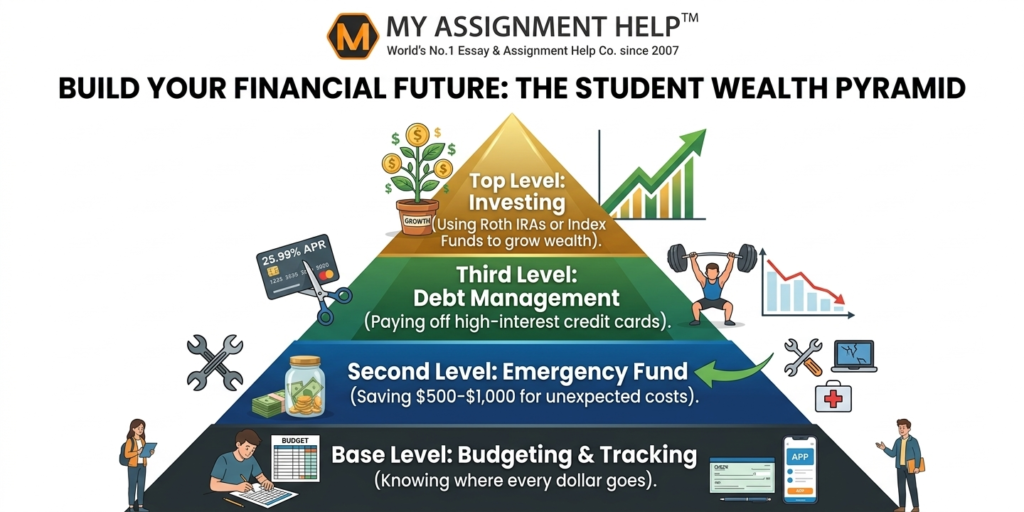
Credit card companies often target college campuses, offering “free” perks for signing up. A financially literate student knows that a 24% APR (Annual Percentage Rate) can turn a $500 textbook purchase into a multi-year debt cycle if not managed correctly. Understanding credit scores—the “GPA of adult life”—is crucial for future apartment rentals, car loans, and even employment background checks.
3. Stress Reduction and Mental Health
A study by The Ohio State University found that 70% of college students feel stressed about their personal finances. Financial literacy provides a roadmap, reducing the “fear of the unknown.” When you have a budget and an emergency fund, an unexpected car repair or a lost textbook doesn’t become a crisis that derails your GPA.
4. Strategic Career Planning
Financial literacy allows students to evaluate job offers beyond just the “sticker price” salary. It helps them understand 401(k) matching, health insurance premiums, and the cost of living in different cities.
For those struggling to balance these complex economic theories with their current coursework, getting the best Assignment help can provide the necessary academic support to ensure they graduate with both the degree and the financial acumen needed to succeed.
Data-Driven Insights: The Literacy Gap
Recent data from FINRA’s Investor Education Foundation suggests that individuals with high financial literacy spend less than their income and set aside three months’ worth of emergency funds at much higher rates than those with low literacy.
| Metric | Low Financial Literacy | High Financial Literacy |
| Have Emergency Fund | 28% | 52% |
| Calculate Interest Correctly | 14% | 71% |
| Stress About Bills | 61% | 34% |
Source: FINRA State of U.S. Financial Capability Report.
Key Takeaways for Students
- Budgeting is Not Restriction: It’s a plan for your money. Use the 50/30/20 rule (50% Needs, 30% Wants, 20% Savings).
- Credit is a Tool, Not Free Money: Always pay your statement in full to avoid interest.
- Start Small: You don’t need thousands to invest. Micro-investing apps and student savings accounts are great entry points.
- Education is an Investment: View your tuition as a “Capital Outlay” and ensure you are maximizing the ROI (Return on Investment) by performing well academically.
FAQ Section
Q: When is the best time to start learning about finance?
A: Today. The sooner you understand concepts like inflation and liquidity, the better prepared you are for the real world.
Q: Can financial literacy improve my grades?
A: Indirectly, yes. By reducing financial stress, you can focus more clearly on your studies and academic performance.
Q: Do I need to be a math genius to be financially literate?
A: Not at all. Financial literacy is more about habits, psychology, and basic arithmetic than complex calculus.
Final Thoughts
The transition from the classroom to the boardroom is fraught with financial hurdles. By treating financial literacy as a core part of your “educational power-up” kit, you ensure that you aren’t just earning a degree, but building a foundation for a life of freedom and security.
Author Bio:
David Miller is a Senior Academic Consultant and Finance Specialist at MyAssignmentHelp. With over a decade of experience in corporate finance and educational counseling, David has helped thousands of students navigate the complexities of fiscal management and academic excellence. He holds an MBA from NYU Stern and is passionate about empowering the next generation with the tools they need for financial independence.
References:
U.S. Department of Education, Federal Student Aid Portfolio Summary.
National Endowment for Financial Education (NEFE), 2023 Trends in Financial Education.
FINRA Investor Education Foundation, “Financial Capability in the United States.”
The Ohio State University, “National Student Financial Wellness Study.”