You To or You Too Which Is Correct 2026
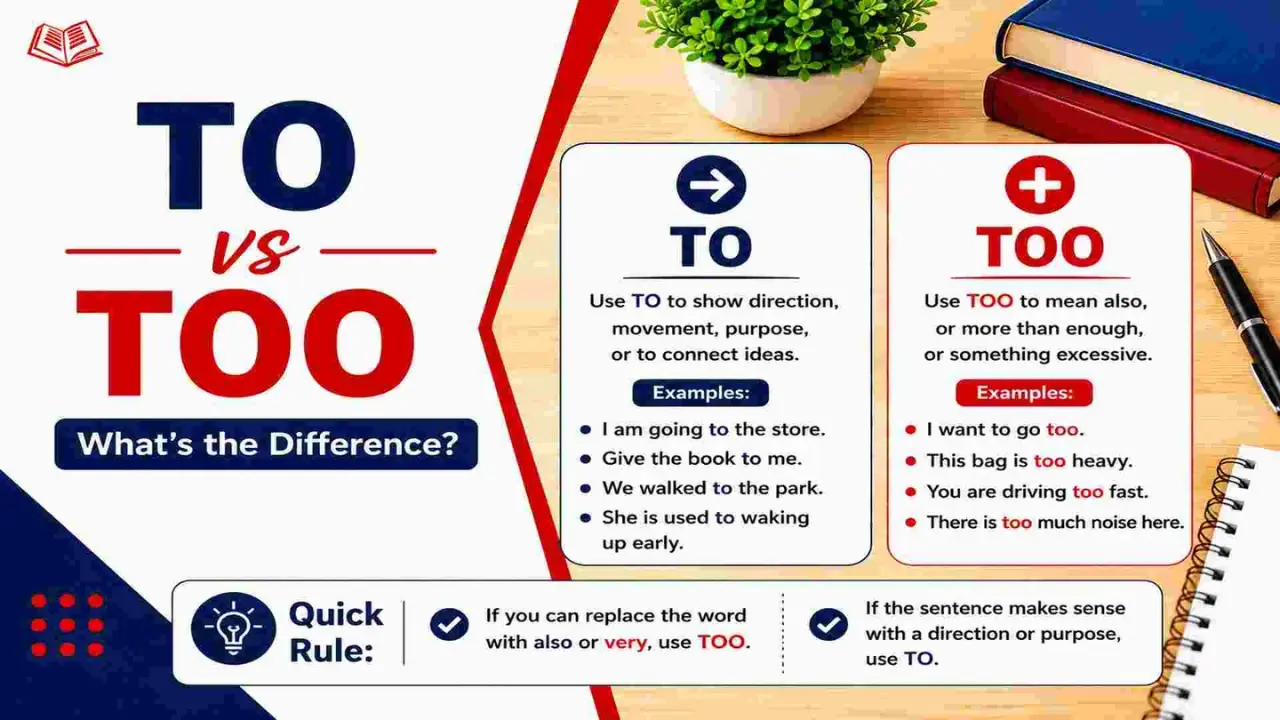
You too is correct when you mean also you or when you return a wish, such as Have a nice day. You too! By contrast, you to is usually part of a longer sentence, as in I need you to listen. The choice between You To or You Too depends on what the words are doing in the sentence.
The confusion is understandable because to and too sound alike. They have different meanings and grammatical jobs, though. A quick check of the intended meaning will usually tell you which spelling belongs.
You To or You Too, You too means also you
You To or You Too, Use you too when too means also, as well, or the same applies to you. Here, too is an adverb that adds a person or thing to what has already been said.
It often appears as a short reply to a greeting, compliment, or good wish:
- “It was great to meet you.” “You too.”
- “Have a safe trip!” “You too!”
- “I’m excited about the concert, and you too seem excited.”
- “You deserve a break too.”
In a reply, “You too” is a shortened form of a fuller thought. For example, after “Have a good weekend,” it means “Have a good weekend too.” The omitted words are understood from the conversation.
You to needs more words around it
You To or You Too, You to is not normally a complete reply or a standalone sentence. It commonly appears when to introduces an infinitive verb: the base form of a verb, often following words such as want, need, ask, tell, or expect.
| Sentence | Why “to” is used |
|---|---|
| I want you to stay. | “To stay” names the action wanted. |
| She asked you to call her. | “To call” explains what she asked you to do. |
| We need you to arrive early. | “To arrive” identifies the needed action. |
| They expect you to follow the rules. | “To follow” completes the verb “expect.” |
How to choose between You To or You Too
You To or You Too, Ask one simple question: Does the sentence mean “also” or “as well”? If yes, use too. If the next word is a verb and the phrase describes an action someone should perform, use to.
- Try replacing the word with “also.” If the meaning still works, choose too. Example: “I like that movie too” becomes “I also like that movie.”
- Look for a verb after “to.” In “I need you to help,” help is a verb. Use to.
- Check whether it is a returned wish. A response such as “Take care!” usually takes “You too!”
- Read the whole sentence aloud, then check the meaning rather than the sound. Pronunciation will not distinguish the two words, but grammar will.
Common examples and corrections
You To or You Too, These examples show the most frequent mix-ups:
| Incorrect | Correct | Reason |
|---|---|---|
| Have fun, you to! | Have fun, you too! | The speaker means “have fun as well.” |
| I told you too wait. | I told you to wait. | “To wait” is an infinitive verb phrase. |
| I want too thank you. | I want to thank you. | “To thank” follows “want.” |
| You are coming too, right? | You are coming too, right? | “Too” means “also.” |
| She invited you too. | She invited you too. | “Too” means that you were included as well. |
Do not confuse you to with to you
You to or you too: the order of the words matters. You to often leads into an action: I expect you to understand. To you usually indicates direction, recipient, or relationship: I gave the note to you.
- Can you help me? — I need you to help me.
- Who received the note? — I gave it to you.
Both phrases can occur in the same sentence: I want to give this to you. Here, the first to belongs with the verb give, while the second to identifies the recipient.
Other meanings of too
You To or You Too, Although you too usually means you also, too has another common meaning: more than is wanted, suitable, or possible. In that sense, it is often followed by an adjective or adverb.
- The coffee is too hot to drink.
- You are driving too fast.
- That box is too heavy for me to lift.
This meaning is different from also, but the spelling remains too. In You are too late, the sentence does not mean you are also late in the usual sense. It means the arrival is later than is acceptable for the situation.
Why to, too, and two are easy to mix up
These three words are homophones in standard English: they are pronounced alike but spelled differently and used differently. Context is the only dependable guide.
| Word | Main use | Example |
|---|---|---|
| to | Shows direction, relationship, or an infinitive verb | Please talk to me. / I want to leave. |
| too | Means “also” or “more than enough” | I want to go too. / It is too noisy. |
| two | The number 2 | We have two tickets. |
Using You too in messages and conversations
You To or You Too, You too is natural in both speech and informal writing. It works well in text messages, emails, comments, and everyday conversation when responding warmly and briefly.
For example:
- “Good luck with your interview!” “Thanks, you too!”
- “Enjoy your holiday.” “You too.”
- “I hope you feel better soon.” “Thank you. I hope you do too.”
The final example uses do too because the reply refers to an action or state already mentioned: feeling better. English often uses do to avoid repeating the full verb phrase.
When a short reply needs more than You too
You To or You Too, You too works only when the same wish, instruction, or statement reasonably applies to both people. It may sound odd if the original words are not something the listener can return.
For instance, if someone says, Congratulations on your new job, replying You too only makes sense if the other person has also started a new job. A clearer response might be Thank you! Likewise, after “I’m sorry for your loss,” “Thank you” is appropriate; “You too” could unintentionally imply that the other person has suffered a similar loss.
Frequently asked questions
Is You To or You Too a complete sentence?
In conversation, yes. It is an accepted shortened response in which the rest of the sentence is understood. For example, “You too!” can stand for “Have a good day too.”
Is you to ever correct by itself?
Usually no. It generally needs surrounding words, especially a verb after to, as in “I want you to come.”
Should I write thank you too or thank you to?
Use “thank you too” when you are thanking someone in return: “Thank you too.” Use “thank you to” when naming the recipient of thanks: “Thank you to everyone who helped.”
Which is correct: I miss you too or I miss you to?
“I miss you too” is correct if you mean that you also miss the person. “To” does not fit that meaning.
Can too come before you?
Yes, but the emphasis may change. “I invited you too” means you were invited as well. “I invited too you” is not standard English. In most cases, place too after the person, verb phrase, or clause it adds to.
The simple rule to remember
For You To or You Too, use you too for “you also” and for returned wishes such as “Have a great day!” Use you to when to leads into an action, as in “I need you to reply.” Once you check whether the meaning is “also” or an action to be done, the correct spelling becomes clear.