Current Phase of the Moon Emoji Meaning and Symbols
A current phase of the moon emoji is not one emoji that updates itself each night. Standard emojis are fixed Unicode characters, so you need to check a reliable lunar calendar or moon-phase feature, then choose the matching moon symbol. The eight main moon-phase emoji run from the dark new moon through the full moon and back to a waning crescent.
This makes moon emoji useful for calendars, captions, journals, reminders, and messages. The key is knowing which symbol matches the phase shown for your date and time zone.
Is there Current Phase of the Moon Emoji?
Current Phase of the Moon Emoji, No. Standard moon emoji do not automatically reflect the real-time moon phase. They are text characters that remain the same after you send or post them. An app, website, calendar, or phone widget may display the live phase, but it is the app that updates the information—not the emoji itself.
For example, typing always produces the full moon emoji, even when the Moon is a crescent in the sky. To share tonight’s phase accurately, first look up the phase, then copy the corresponding symbol.
Moon phase emoji chart
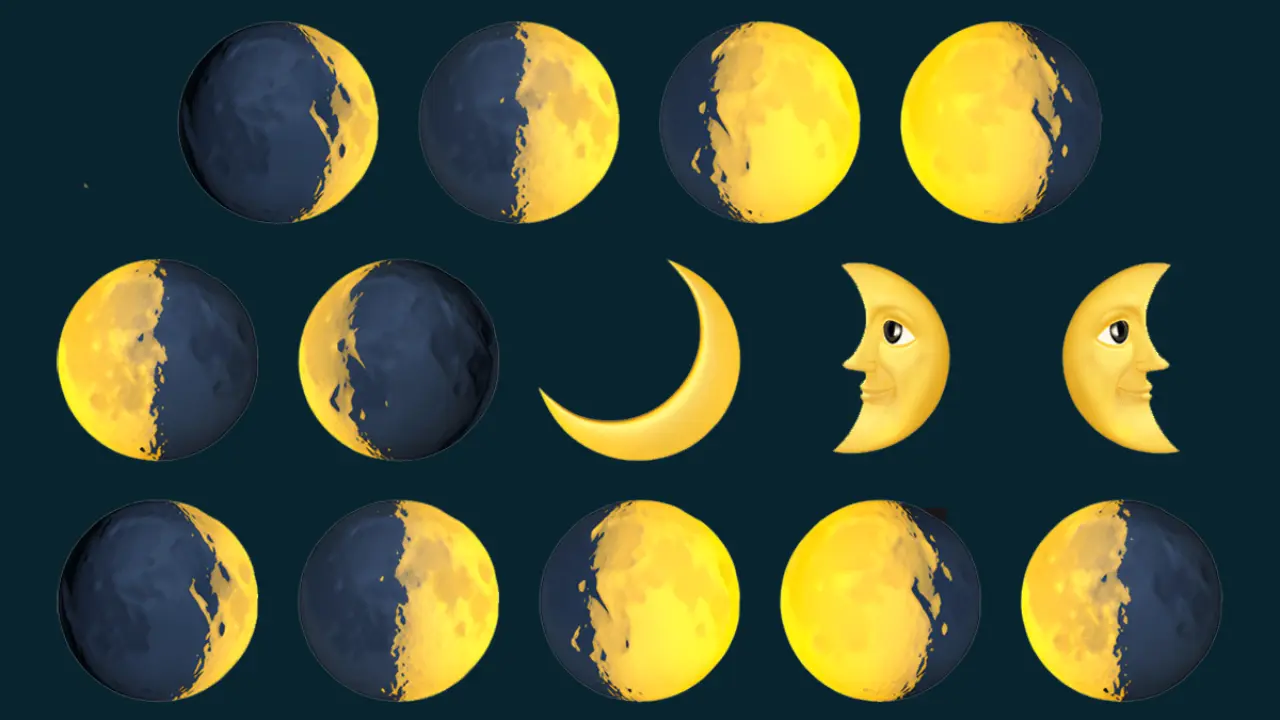
Current Phase of the Moon Emoji, The eight symbols below represent the usual sequence of lunar phases. Their appearance can vary slightly across Apple, Google, Microsoft, Samsung, and other platforms, but their basic meanings stay the same.
| Emoji | Phase name | What it represents |
|---|---|---|
 | New moon | The Moon appears dark because its sunlit side faces mostly away from Earth. |
 | Waxing crescent | A thin bright crescent is growing after the new moon. |
 | First quarter | About half of the Moon’s visible disk is illuminated, and the lit portion is increasing. |
 | Waxing gibbous | More than half is illuminated and the Moon is moving toward full. |
 | Full moon | The Earth-facing side appears fully illuminated. |
 | Waning gibbous | More than half remains illuminated, but the bright portion is shrinking. |
 | Last quarter | About half is illuminated, and the lit portion is decreasing. |
 | Waning crescent | A thinning crescent appears before the next new moon. |
“Waxing” means the visible illuminated portion is growing. “Waning” means it is shrinking. “Gibbous” describes a Moon that looks more than half lit but is not full.
How to choose the current phase of the moon emoji
Current Phase of the Moon Emoji, Check a moon-phase calendar, weather app, astronomy app, or a device feature that identifies the lunar phase for your location. Then match the phase name to the chart above and copy the associated emoji.
- Find the phase listed for the date you mean, such as waxing crescent or full moon.
- Check the date and time zone, especially close to a new moon, first quarter, full moon, or last quarter.
- Select the matching emoji from the chart or your emoji keyboard.
- Use the phase name in words when accuracy matters, such as “Waxing gibbous tonight .”
A lunar phase changes continuously rather than switching instantly from one visual state to another. Calendars group that gradual change into familiar phase names. As a result, two sources may use slightly different labels near a phase boundary while still describing nearly the same appearance.
Why location and time zone can affect the answer
Current Phase of the Moon Emoji, The Moon’s phase is produced by the changing geometry of the Sun, Earth, and Moon. The underlying astronomical moment is shared worldwide, but the local calendar date can differ by time zone. A full moon that occurs shortly after midnight in one place may still fall on the previous evening somewhere else.
Your location also changes how the Moon looks in the sky. Observers in the Northern and Southern Hemispheres can see the illuminated side oriented differently. Moon-phase emoji do not rotate to match your hemisphere; they use a standardized graphic design. They communicate the named phase, not an exact view from a particular location.
Moon symbols commonly confused with phase emoji
Current Phase of the Moon Emoji, Not every moon-related emoji is a phase indicator. These symbols are widely used in casual writing, but they have different Unicode names and purposes.
- Crescent moon: A general crescent-moon symbol. It may suggest nighttime, sleep, calm, fantasy, or a crescent phase, but it is not a precise current-phase display.
- New moon face: A dark moon with a face. It is often used for humor, mystery, irony, or an expressive tone.
- Full moon face: A full moon with a face, often used in playful or slightly awkward messages.
- First quarter moon face and last quarter moon face: Stylized half-moon faces. They are expressive alternatives, not neutral astronomy icons.
- and : Star and sparkle symbols that can add a night-sky feeling but do not identify a moon phase.
Current Phase of the Moon Emoji, For a dated lunar tracker or an astronomy note, use the neutral eight-phase symbols. For a bedtime text or an aesthetic caption, they may be the more recognizable choice.
What the moon emojis mean in everyday messages
Current Phase of the Moon Emoji, Moon phase symbols can be literal, decorative, or symbolic. Context usually tells the reader which meaning is intended. A post saying “Full moon hike tonight ” is likely literal, while “Starting over ” uses the new moon as a metaphor for a fresh beginning.
Common associations include:
- New moon: beginnings, reflection, quiet, or a new cycle.
- and Waxing phases: growth, momentum, progress, or anticipation.
- Full moon: completion, brightness, celebration, intensity, or a night-time event.
- and Waning phases: winding down, release, rest, or closure.
- Crescent moon: sleep, goodnight wishes, nighttime, or a dreamy mood.
Current Phase of the Moon Emoji, These associations are informal. An emoji does not carry one universal emotional meaning, so it helps to pair it with plain words when a message could be misunderstood.
Copy-and-paste moon phase emojis
Here is the full sequence in order:
For a shorter collection of general moon symbols, use:


Current Phase of the Moon Emoji, On most phones and computers, searching your emoji picker for “moon” should reveal several of these options. Search results and artwork depend on the operating system, keyboard, and app. If a symbol displays as an empty box, the device or font may not support that emoji.
Practical ways to use moon phases
Current Phase of the Moon Emoji, A phase emoji works best as a compact visual label. It can make a repeated schedule easier to scan without replacing important details.
- Personal journals: Add the phase beside daily entries to connect notes with a lunar cycle.
- Calendars: Mark major phases such as,,, and on monthly plans.
- Social posts: Pair the accurate symbol with the date, location, or activity.
- Group reminders: Use a full moon or new moon marker for recurring club, photography, gardening, or stargazing plans.
- Creative writing: Use a moon symbol to set a quiet, nocturnal, mysterious, or celebratory tone.
For a public event, avoid relying on an emoji alone. Include the full date, local time, and location, because the symbol cannot provide those details.
FAQ
Which Current Phase of the Moon Emoji?
It is the standard full moon emoji. The similar symbol is a full moon with a face and has a more playful or expressive style.
What is the difference between a new moon and a dark moon emoji?
It is named the new moon emoji and is the standard phase symbol. is the new moon face emoji, a dark disk with facial features. The first is better for a phase chart; the second is usually used for expression or humor.
Why does the moon emoji look different on another phone?
Emoji characters have shared code points, but each platform supplies its own artwork. The same moon phase should retain its general meaning even if its color, shading, or shape differs.
Can I use it to mean the current moon phase?
You can use it casually to mean “moon” or “night,” but it does not identify a specific phase with the same precision as through. Check the lunar phase and choose the matching symbol when the distinction matters.
Does the bright side of the emoji match what I see outside?
Not always. The orientation of the illuminated portion can appear different depending on hemisphere and viewing position, while emoji artwork is standardized. Use the emoji as a phase label rather than a location-specific sky diagram.
A simple way to share tonight’s lunar phase
Use a moon calendar or live lunar feature to identify the phase for your local date, then select its matching symbol from the eight-phase sequence. The current phase of the moon emoji is therefore a useful shorthand, but it is not a live astronomical indicator. Pair it with the phase name and date whenever clarity matters.